

How Establishing Roles Improves AI Responses
Artificial intelligence tools like ChatGPT and Google Bard can produce impressive results—but only when they clearly understand who they are helping and how they should respond. One of the most powerful yet simple prompt engineering techniques is establishing roles. By defining roles for both the AI and yourself, you can dramatically improve clarity, relevance, and usefulness in AI-generated outputs. Highly relevant topics in the current article are: establishing roles, improve AI responses, prompt engineering tips, role-based prompts
What Does “Establishing Roles” Mean in Prompt Engineering?
Establishing roles means explicitly telling the AI:
- Who it should act as (e.g., a data quality engineer, Excel expert, or Python developer)
- Who you are (e.g., a beginner analyst, business manager, or student)
This added context helps the AI tailor its language, depth, and structure to match your exact needs.
Why Role-Based Prompts Work Better
AI language models do not truly understand intent—they infer it from patterns and context. When roles are not defined, responses tend to be generic. Assigning roles reduces ambiguity and helps the model align its response with your expectations.
Key benefits include:
- More targeted explanations
- Better alignment with your skill level
- Clearer step-by-step guidance
- Improved tone and structure
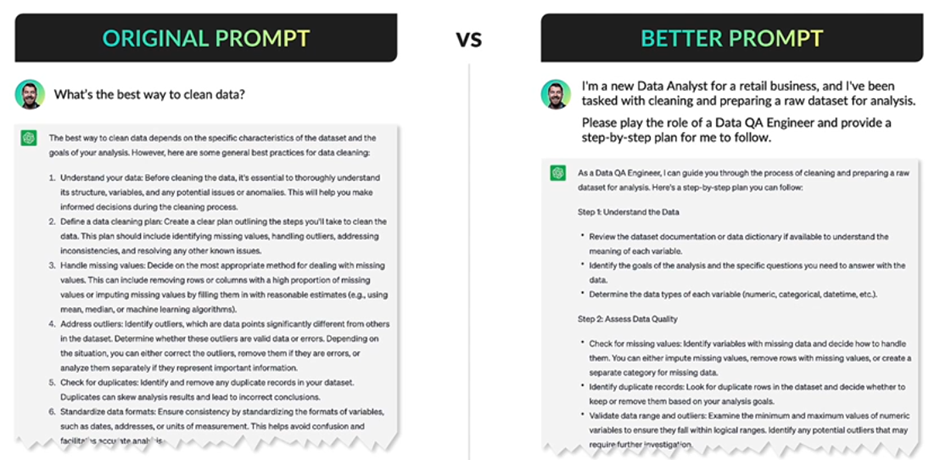
Basic Prompt vs. Role-Based Prompt: A Simple Example
Basic Prompt:
What’s the best way to clean data?
This produces a general, high-level response that may not suit your situation.
Improved Role-Based Prompt:
I’m a new data analyst at a retail company. Act as a senior data quality engineer and give me a step-by-step plan to clean retail sales data.
With roles established, the AI now understands:
- Your experience level
- The business context
- The type of response you need
As a result, the output becomes more practical, structured, and actionable.
How to Apply Role Assignment Effectively
To get the best results:
- Clearly state your role or background
- Assign a specific professional role to the AI
- Ask for a format that matches your goal (steps, checklist, explanation, etc.)
This technique is especially effective for:
- Data analysis and cleaning
- Coding and debugging
- Business strategy explanations
- Training and learning new tools
Final Takeaway
Establishing roles is a simple prompt engineering strategy that delivers disproportionately better results. By clarifying who the AI is and who you are, you guide the model toward responses that are more relevant, accurate, and useful. When combined with clear instructions and context, role-based prompts can significantly enhance your productivity with AI tools.
Learn how structured prompts improve AI outputs in this comprehensive guide to prompt engineering techniques
→ prompt engineering techniques guide Explore academic insights on AI prompting in this systematic review of prompt engineering in education
→ prompt engineering in higher education research Understand how assigning roles enhances responses through persona and role-based prompting strategies
→ role-based prompting techniques explained Get a clear definition and key methods from this complete overview of prompt engineering concepts
→ what is prompt engineering and how it works Discover why role prompting improves accuracy in this advanced role-based prompting explanation
→ benefits of role-based prompting in AI See how structured prompts increase AI performance in this latest prompt engineering trends and techniques (2026)
→ latest prompt engineering techniques 2026 Read research-backed insights on role simulation in AI from this study on role-based prompting effectiveness
→ role prompting improves contextual AI responses


More Articles
Topic 13. How Setting the Right Tone in Prompts Improves AI Responses
Learn how setting the right tone in prompt engineering improves AI responses. Discover practical prompt engineering tips to get clearer, more accurate results from ChatGPT and Google Bard....
Learn More >